
Taylor County VINE Coverage
Florida VINE is a notification service for a person-specific custody check. Official Florida sources say the network includes Florida county jails, the Florida Department of Corrections, and the Department of Juvenile Justice. That supports checks involving Taylor County Jail and Florida state-prison custody. The dynamic site did not expose a fixed agency roster during research, so coverage should not be turned into a promise that every old Taylor record will remain visible.
VINE is not a complete release log. It can present current custody or recently released people when the reporting data is available, and it can send notice after a status change. Taylor County Jail remains the source for the physical jail release sheet. FDC remains the source for a state-prison release or supervision record. The Taylor Clerk docket can explain the bond, dismissal, sentence, or order that supplied legal authority for a release.
| Custody layer | Use VINE? | Confirm with |
|---|---|---|
| Taylor County Jail | Yes, for a person-specific status or alert | TCSO release record and court docket |
| Florida state prison | Yes, for covered custody events | FDC release, population, or supervision database |
| Federal BOP custody | No substitute coverage | BOP Inmate Locator |
| ICE detention | No substitute coverage | ICE Online Detainee Locator System |
The FDC VINE Services page documents Florida's coverage and contact path.
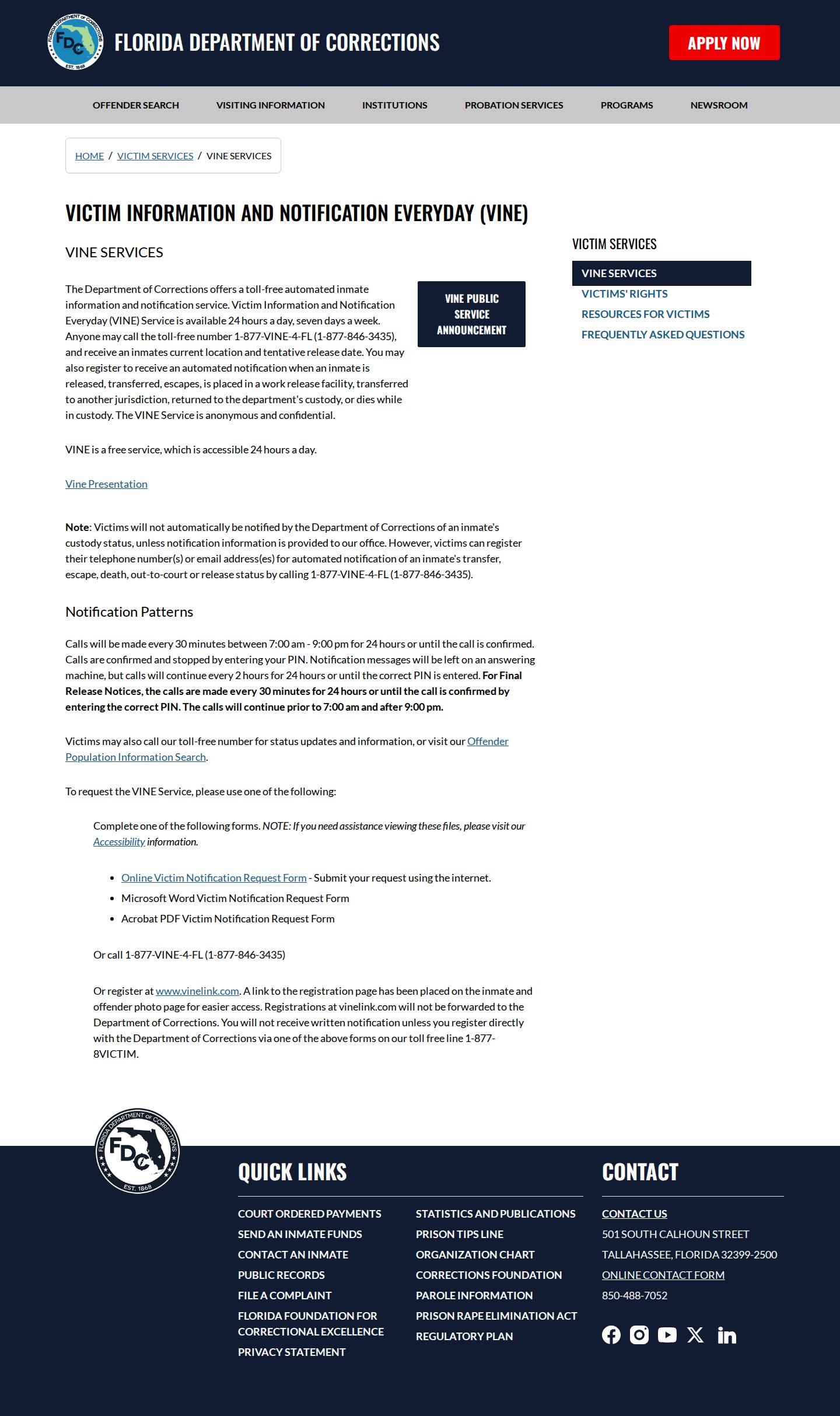
This state explanation places VINE in its proper role: timely custody notice, followed by direct confirmation when the exact release event or destination matters.
Search Taylor County VINE Records
Start with the person's full first and last name. An agency identifier is stronger when one is known. VINELink may offer partial-name matching and an option to include photos. Use those tools to narrow the result, then compare the agency, identity details, and image instead of relying on a name alone.
- Open Florida in VINELink and choose the custody or “Search for Someone” path.
- Enter the full first and last name or an available agency identifier. Try an alias or partial spelling if the first search fails.
- Review possible matches. Confirm that the reporting agency and identifiers fit the Taylor County custody facts.
- Open the matched card. Read Custody Status and Custody Detail exactly as displayed.
- When a supervision result appears, read Supervision Status separately from physical custody.
- Call the reporting facility if the record is missing, archived, delayed, or unclear.
The official Florida custody-search entry is the correct starting screen.
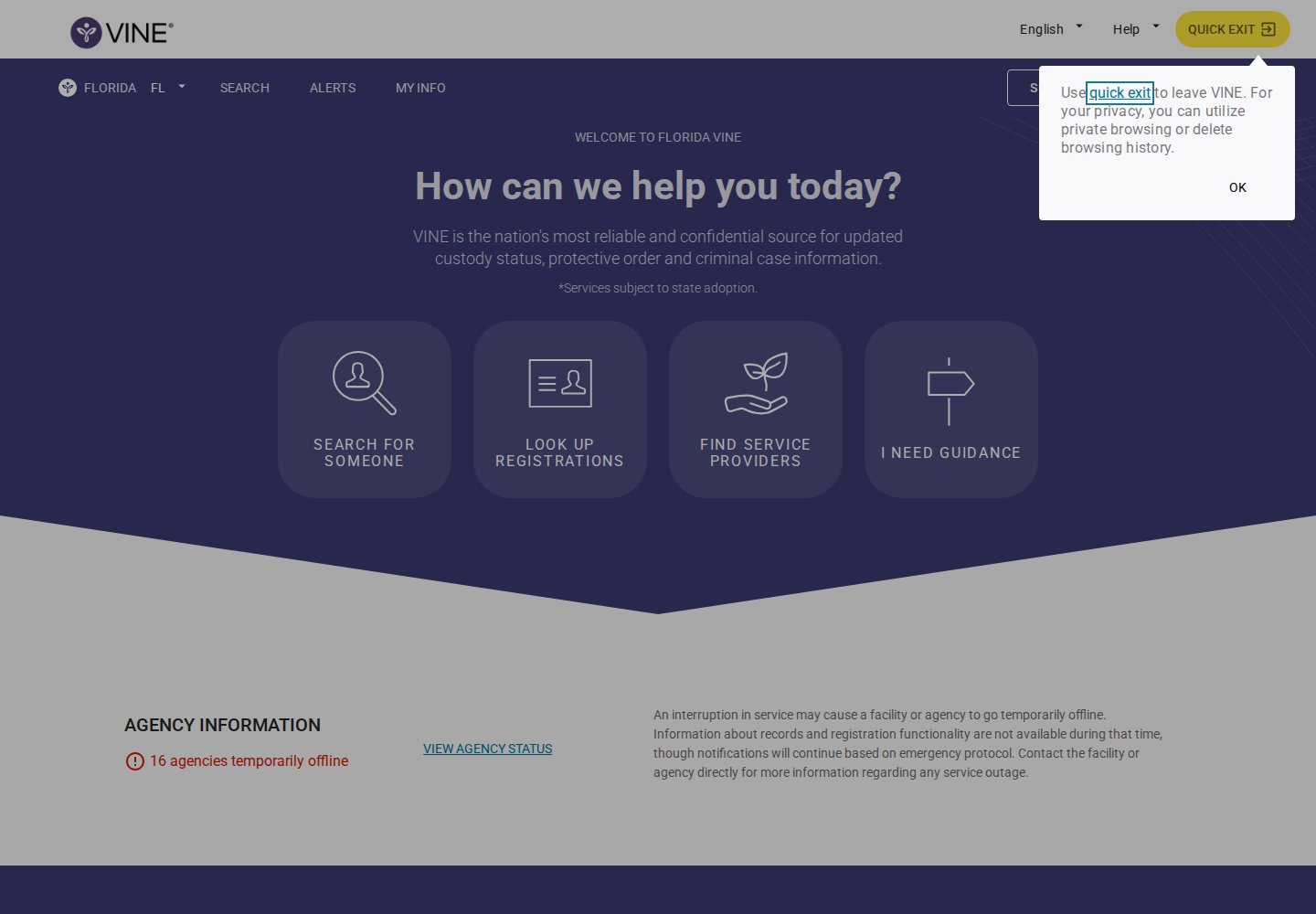
The screen supports a one-person query, not a browseable Taylor County release feed. Searching by a broad name can return more than one agency or person, so identity checks remain part of the process.
Note: VINELink may show current or recently released people, but no fixed Taylor County retention period was verified.
Taylor County VINE Result Fields
VINELink's current interface identifies core status fields without guaranteeing the same optional data for every agency. A Taylor County result should be read as reported, not filled in from what another jurisdiction happens to show. Research did not capture a lawful live Taylor released-person result. Do not assume the literal word “Released,” a release reason, a photo, or an exact release date will appear.
| Field | What it can establish | Limit |
|---|---|---|
| Custody Status | The status supplied to VINE | May lag the originating agency |
| Custody Detail | More context about custody or movement | May not give the legal release reason |
| Supervision Status | A separate community-supervision state | Not the same as physical custody |
| Agency and identifiers | Helps distinguish similar names | Must be matched to known facts |
| Scheduled date, if supplied | A planned or tentative event | Not proof that release occurred |
“Out of custody” is a custody-status signal. It does not tell the reader whether Taylor County Jail released the person to the community, transferred the person to FDC, or delivered the person to another authority. For a time, reason, or destination, ask TCSO for the booking and release record. A court order can explain legal authority but may not record the moment the person left the jail.
Taylor County VINE Release Alerts
Registration begins on the correctly matched person record. Choose Get Notified or the current status-change action, then select the offered contact methods. Current VINE supports phone, text, email, and in-app alerts. More than one method can reduce the risk that a changed number, full inbox, or network problem causes a missed notice.
- Open the matched record and choose the notification action.
- Select phone, text, email, in-app notice, or more than one available method.
- Enter each destination carefully and choose a language where the interface offers one.
- For a phone notice, create a four-digit PIN. Use the PIN followed by the pound sign during the call to acknowledge it and stop repeat calls.
- Complete every confirmation step until VINELink says registration succeeded.
- Update or replace the registration if the phone number or email address changes.
Telephone registrations are separate. Florida guidance favors a direct phone line over a switchboard. Text and email are generally single notices for each status change, while phone calls may repeat until acknowledged. A text registration may also ask for a PIN.
Registration is confidential. Still, an alert is secondary electronic notice rather than a certified record or safety guarantee. It can report events such as release, transfer, escape, death, or out-to-court movement when that event reaches the system. Ask the reporting agency for the actual event record if the difference between transfer and release matters.
Taylor County VINE PIN Codes
VINE uses two codes for different purposes. The alert PIN is four digits. It is tied to notification acknowledgment, especially a phone call. Entering that PIN and the pound sign tells the system the call was received and stops repeats. Pick a number that is not easy for someone else to guess.
A VINELink account can separately require a six-character confirmation code sent by email or text. That code confirms account access or setup. It is not the four-digit alert PIN. Mixing them can leave a registration unfinished even though one screen or message was completed.
- Four-digit PIN
- A notification code used to acknowledge certain alerts and stop repeated calls.
- Six-character confirmation
- A separate code that may confirm a VINELink account by email or text.
- Status change
- An agency-reported custody movement or event that can trigger an alert.
- Reporting agency
- The jail or corrections agency that supplies the underlying custody information.
Note: Finish registration only after the interface confirms success, and keep every selected contact method current.
Taylor County FDC Notification Path
FDC also maintains an official victim-notification form under Florida Statutes section 944.605. It is for victims, survivors, and their representatives. The form asks for registrant, victim, inmate, and case details. Telephone information can enroll automated movement calls involving release, transfer, escape, death, or out-to-court activity.
That formal process is not the general-public replacement for VINELink. A person who does not fit the form's stated role should use direct VINELink registration or call Florida VINE at 1-877-846-3435. Direct registration in VINELink is not necessarily shared with FDC Victim Services, so do not assume that completing one process completed the other.
FDC Victim Services lists 1-877-884-2846 and office hours from 8 a.m. to 5 p.m. Eastern, Monday through Friday. The VINE phone line is available around the clock for automated or operator support. Use the channel that matches the registrant's role and the custody system involved.
Florida also has an FDLE Sexual Offenders and Predators Search and Florida Offender Alert. Those services apply only to people who have a statutory registration duty. They may show a registration status, address, or notification data after release, but they are not a substitute for VINE and do not prove that every person from a Taylor County booking was released. A missing registry result says nothing about an ordinary jail or prison record.
Taylor County VINE Search Limits
No result is not release proof. Try the full name, aliases, partial spelling, and known identifier. Then call the facility that last held the person. A Taylor County Jail booking can end in community release, FDC commitment, transfer to another county, or a hold for another authority. VINE may show a status change without supplying the precise release authority or destination.
Federal and immigration systems sit outside this coverage. The BOP Inmate Locator is the public path for a federal sentence and can show a historical release date with “not in BOP custody.” ICE uses its own detainee locator. Neither result answers whether a later state, local, or other custody event followed. Florida VINE cannot replace those locators, and those locators cannot replace a Taylor jail record.
FDC also divides state data by legal state. Inmate Population covers current state prisoners. Inmate Release covers scheduled or completed state-prison releases. Supervised Population covers post-release community supervision. Absconder covers people who stopped making themselves available to FDC supervision. Search the database that matches the question.
The same separation matters when a Taylor County result disappears. A person can leave the jail roster because of release, state-prison commitment, transfer, or another hold. If FDC Population contains the person, the event was a move into state custody rather than a release to the community. If FDC Release contains a completed state record, check Supervised Population next. If none of those systems resolves the event, request the TCSO release or transfer fields and read the Taylor Clerk case.
For immediate county clarification, Taylor County Jail publishes 850-584-4333 and weekday information hours from 8 a.m. to 5 p.m. TCSO administrative records can be reached at 850-584-4225. Ask whether the booking ended in release or transfer and which existing record contains the date, time, authority, and destination. That direct question is more precise than asking why a name is gone.
For a complete Taylor release check, combine VINE with the originating record. The Taylor County released-inmate lookup sets out the county jail, court, FDC, and records-request paths. That cross-check protects against treating a stale alert, a missing result, or a transfer as proof of community release.