
Taylor County Three-Day Feed Status
The Taylor County Sheriff’s Office does not publish a rolling 72-hour released-person view. Its official SmartWEB jail entry opens to “BOOKED Last 24 Hours.” Search controls allow beginning and ending booking dates, but those dates mark admission to jail. No public control was verified for release date, released-only status, or a three-day release interval.
A three-day booking query can help locate an older booking number. It cannot show that a person left within the same three days. Someone booked earlier may be released during the target window, while someone booked within it may still be held. TCSO also publishes no update cadence or post-release web-retention period. The absence of a name may reflect display limits, a transfer, or a changed custody layer.
Taylor 72-Hour Release Window
A 72-hour range is useful when the event may have occurred over a weekend, near a holiday, or before someone could contact the records office. Taylor County Jail posts general information hours on weekdays, and TCSO Records fills public-record requests during its own weekday fulfillment hours. A Friday-to-Monday interval can therefore be easier to frame as one precise records request than as three separate guesses.
The time boundary still needs care. State the start and end timestamp, including the local time zone, rather than asking for “the last few days.” A rolling 72-hour window changes every minute. A calendar range does not. Ask whether an existing report or export records release date and time, authority, and destination. The custodian need not create a list if no such record exists, but the underlying booking-release sheets can still establish each event.
Note: Use fixed timestamps for a Taylor County release request so the custodian and requester are working from the same three-day interval.
Check Taylor County 72-Hour Releases
The three-day search should move from the county event record to corroborating systems. This order avoids treating a current roster, a court action, or a state-prison record as if each answered the same question.
- Set an exact start and end timestamp for the 72-hour span. Note whether a holiday or weekend falls inside it.
- Use SmartWEB to collect names, booking dates, booking numbers, MNI numbers, or case numbers that can narrow the request.
- Contact TCSO Records at public-records@taylorsheriff.org, 850-584-4225, by mail, or in person. Ask for existing release events in the bounded period.
- Search Florida VINE for a named person’s custody status or register for a later status-change alert.
- Read every related Taylor Clerk case for bond, dismissal, sentence, probation, warrant, or transfer authority.
- When a state-prison sentence or transfer appears, search FDC population, release, and supervision records with the person’s DC number.
Call the jail at 850-584-4333 when an immediate custody answer is needed. Ask whether the Taylor booking ended in community release or transfer and which record documents the result. A verbal answer helps with routing, but the written release record is stronger evidence of the date, time, and authority.
Taylor Three-Day Release Fields
No public Taylor County table displays these fields for a three-day window. They are the fields that make an agency record useful. Include them in a Chapter 119 request, along with a request for electronic delivery and a cost estimate. If TCSO uses a code, ask for any existing code definition rather than asking the custodian to write a new explanation.
| Field | Why it matters over 72 hours |
|---|---|
| Full name and date of birth | Separate people who have similar names. |
| Booking and MNI number | Connect one release to one jail stay. |
| Booking date and time | Show when the jail stay began, not when it ended. |
| Release date and time | Place the event inside or outside the fixed three-day range. |
| Release type or authority | Distinguish bond, court order, time served, sentence end, or another reason. |
| Destination or receiving agency | Separate community release from continued custody after transfer. |
| Case number | Link the physical event to the Taylor Clerk’s judicial record. |
A transfer is not a community release. A state-prison commitment moves verification to FDC. A pickup on another county’s warrant or a federal or immigration detainer moves the inquiry to that authority. The Taylor booking can close in every one of these cases, which is why a release-type field without destination may remain incomplete.
Taylor Booking Dates Mislead
Taylor’s distinctive data issue is the mismatch between the name of the public report and the release question. The landing report says “BOOKED Last 24 Hours,” while the sheriff describes the linked jail service as current inmate population. The application code contains dormant references to release inputs, but no usable released-person selector appeared in the public form. A hidden variable is not a public service.
The official Taylor jail view below shows its booking-centered layout.
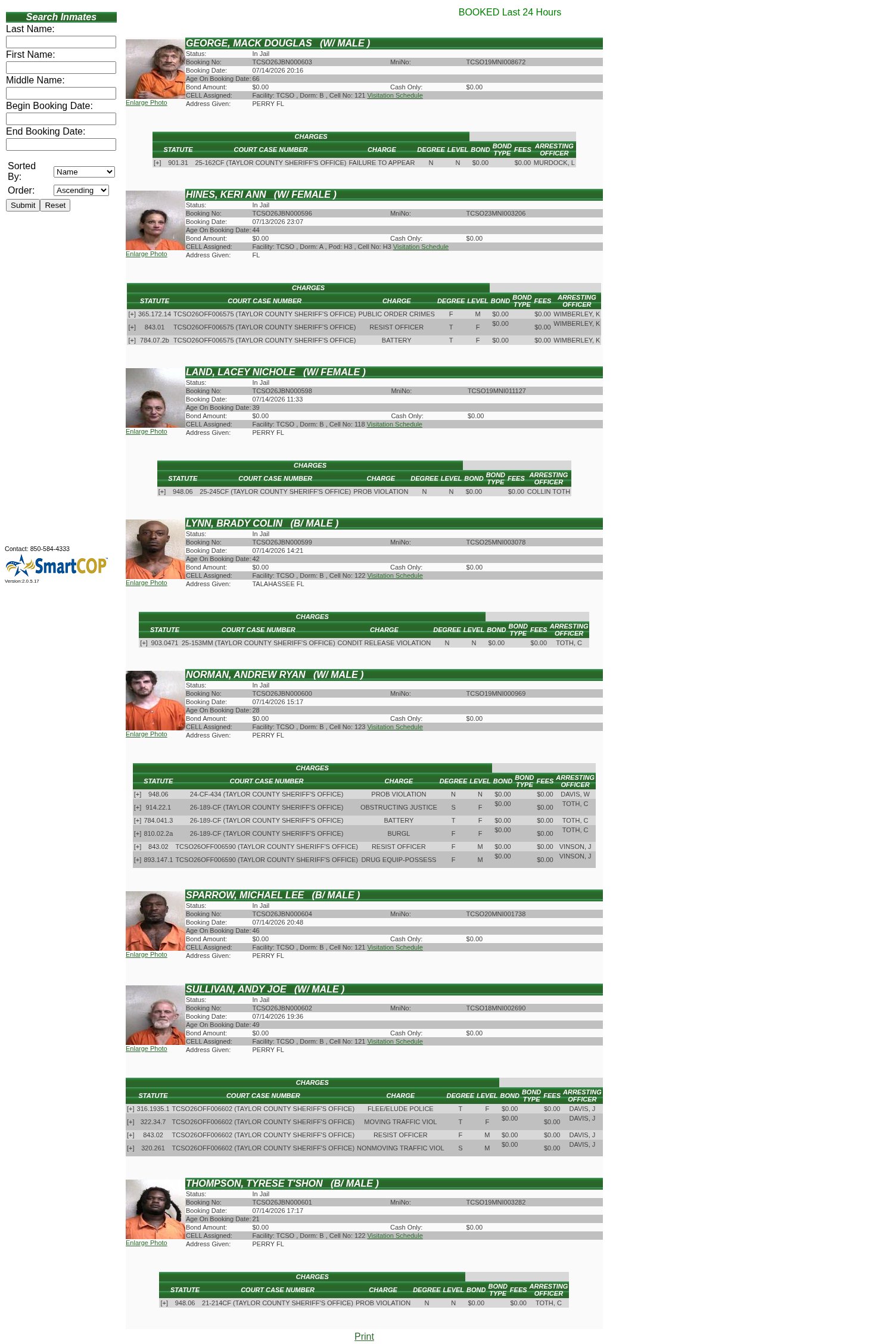
The booking cards may show photos, status, booking numbers, bond details, assigned cell location, charges, and case data. They did not show release time, release reason, or destination. Extending the booking-date controls to three days changes only which admissions are found. It does not create a Taylor County release list.
Note: SmartWEB’s visible booking controls cannot be used to claim an official 72-hour Taylor County released-person filter.
Request Taylor 72-Hour Records
Direct the request to the TCSO Records Custodian at 108 N. Jefferson St., Suite 103, Perry, FL 32347, public-records@taylorsheriff.org, or 850-584-4225. The office says requests may be anonymous, though a delivery method is needed. Posted fulfillment hours are Monday through Friday, 8:30 a.m. to 4:30 p.m., excluding holidays.
A useful request reads: “Please provide existing records identifying bookings released from Taylor County Jail between the stated start and end timestamps, including booking number, release date and time, release type or authority, and destination or transfer agency, with exempt information redacted. Please provide electronic copies and a cost estimate before chargeable work.” Add a person’s name, birth date, booking number, or case number when the request is not for the whole interval.
TCSO states that fulfillment time depends on volume, nature, and staffing. Florida law uses a reasonable-time standard rather than a fixed 72-hour deadline. Actual duplication and extensive-use charges may apply, and part of an estimate may be required in advance. Ask for the cited exemption and a redacted remainder when information is withheld. Active investigative material and protected personal data may have limits, but those limits do not justify withholding every nonexempt release field.
Taylor Weekend Release Checks
A weekend can delay access to records staff without delaying the actual release. Court orders, bond processing, sentence completion, property return, and another agency’s pickup may occur on different schedules. No Taylor County source publishes a standard release hour or guarantees that a web status changes at the moment the jail door opens.
For a Friday evening through Monday evening question, preserve the exact period and call the jail for immediate status. Use VINE as a status-change aid, but remember that an electronic alert is not a certified release record and can lag. Request the event sheet once records staff are available. Then check the Clerk docket for legal authority if the reason matters.
Taylor Release Versus Transfer
Taylor County contains both a county jail and an FDC prison complex. That local structure makes a closed jail booking easy to misread. Taylor Correctional Institution and its Annex are state custody. Movement from the county jail to either facility is a transfer, not release from confinement. Movement between the main unit and Annex is also not release.
| Record outcome | Meaning | Next source |
|---|---|---|
| Released on bond or court order | County physical custody ended, subject to the case and any conditions. | TCSO release record and Clerk docket |
| Time served or sentence complete | The Taylor jail sentence ended. | TCSO event sheet and judgment |
| Transferred to FDC | County booking ended while state custody began. | FDC Inmate Population search |
| Transferred to another authority | Custody continued elsewhere. | Named receiving agency |
| Released from state prison | FDC incarceration ended, perhaps followed by supervision. | FDC Release and Supervised Population searches |
Use the destination or receiving-agency field to resolve the difference. “Not on the Taylor roster” cannot do that work by itself.
Taylor Named-Person Confirmation
A whole-window request answers who left during the three days. A named-person inquiry can move faster because identifiers narrow the search. Supply the full name, date of birth if known, booking or MNI number, booking range, and case number. Ask TCSO for release date, time, authority, and destination. Pair that response with VINE or the court record when the status remains unclear.
The Taylor County 24-Hour Releases route fits a same-day question. The Taylor County released inmate search fits an older or uncertain event because it also covers FDC, federal, immigration, and supervision paths. These time ranges should not change the standard of proof.