
Taylor County Parole or Probation
Florida separates the agency that makes some release decisions from the agency that supervises people in the community. The Florida Commission on Offender Review, or FCOR, decides parole and certain conditional-release matters. Florida Department of Corrections correctional probation officers carry out field supervision. A Taylor County record should therefore be read by both supervision type and responsible agency.
Probation is a court-ordered period of supervision that may be imposed instead of incarceration or after a jail or prison term. Parole is discretionary release before the end of an eligible prison sentence. Florida ended ordinary parole eligibility for offenses committed on or after October 1, 1983, subject to older cases and narrow statutory categories. Conditional release, community control, and probation after a split sentence are distinct labels. They should not all be called parole.
| Record type | How it begins | Best verification path |
|---|---|---|
| Probation | A court sentence or order | FDC Supervised Population and the Taylor court case |
| Parole | An FCOR action for an eligible sentence | Commission Action, then FDC supervision |
| Conditional release | A statutory post-prison term | FDC release and supervised-population records |
| Community control | A court-ordered intensive supervision term | FDC supervision record and court order |
- Discharge
- The formal end of a custody or supervision term.
- Termination date
- The date shown for a supervision term to end, subject to later official action.
- Absconder
- A supervised person who has stopped making themselves available to the supervising agency.
- DC number
- FDC's six-character identifier for a person in its correctional records.
Verify Taylor County Post-Release Supervision
The FDC offender-search menu divides current prison custody, inmate releases, community supervision, and absconders into separate databases. That split is essential. The population search is not the place to confirm a person living under supervision, while the release search does not by itself show whether a community term followed incarceration.
- Gather the full name, date of birth, and six-character DC number when known. A name alone can match more than one person.
- Open Supervised Population and search by name or DC number. Compare the photograph and identifiers before accepting a match.
- Read the supervision type, current location or office, and termination date exactly as shown. Do not turn a projected end date into proof of discharge.
- Run the same DC number in Inmate Release if state prison custody came first. This can connect the release event to the supervision term.
- Check the Taylor Clerk criminal docket for the judgment, sentence, probation term, modification, or termination order when the court imposed the term.
- Call the assigned FDC office for clarification. A public result does not replace reporting directions given to the supervised person.
The official FDC Supervised Population search shows how a result can connect a person to a supervising office and termination field.
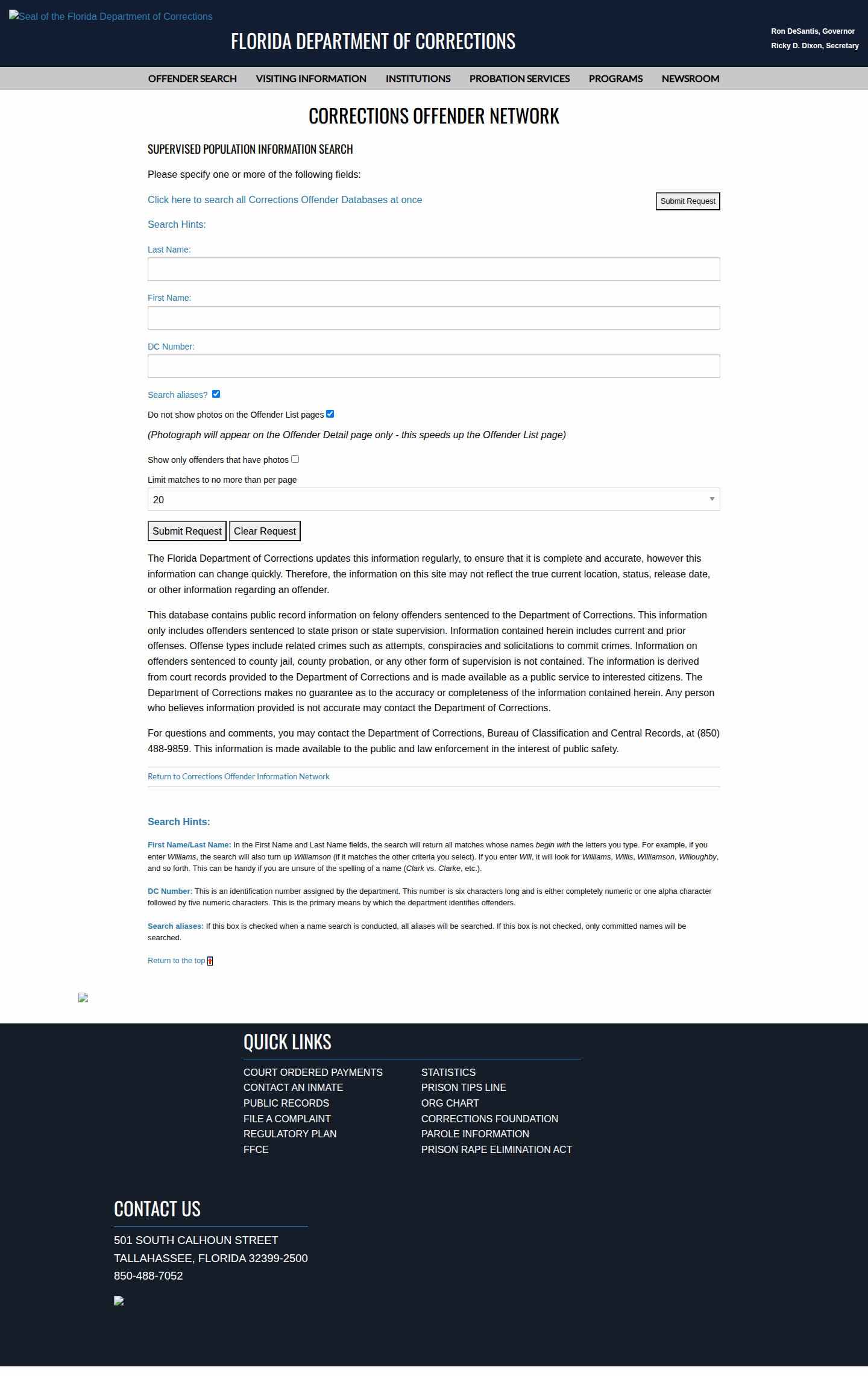
Those fields describe an FDC supervision record. FDC expressly excludes people sentenced only to county jail or county probation, so the Taylor court file remains important when no state record appears.
Note: A missing supervision result is not proof that every legal duty has ended; verify the court order and responsible office.
Taylor County Supervision Office 033
Taylor County is in FDC Community Corrections Circuit 03. The official circuit office list identifies office 033 in Perry. When an FDC detail record names Perry as the current location, that office is the local route for checking which office holds the supervision file. No public walk-in or reporting hours were verified. Call before visiting, and do not assume that general office access is the same as a person's required reporting schedule.
FDC Office 033, Perry
121 North Jefferson Street
Perry, FL 32347-0540
Phone: 850-838-8700
Fax: 850-223-4566
Hours: Call first; public walk-in hours were not verified.
The official Circuit 03 page also places Taylor among the counties served and provides the Perry office contact.
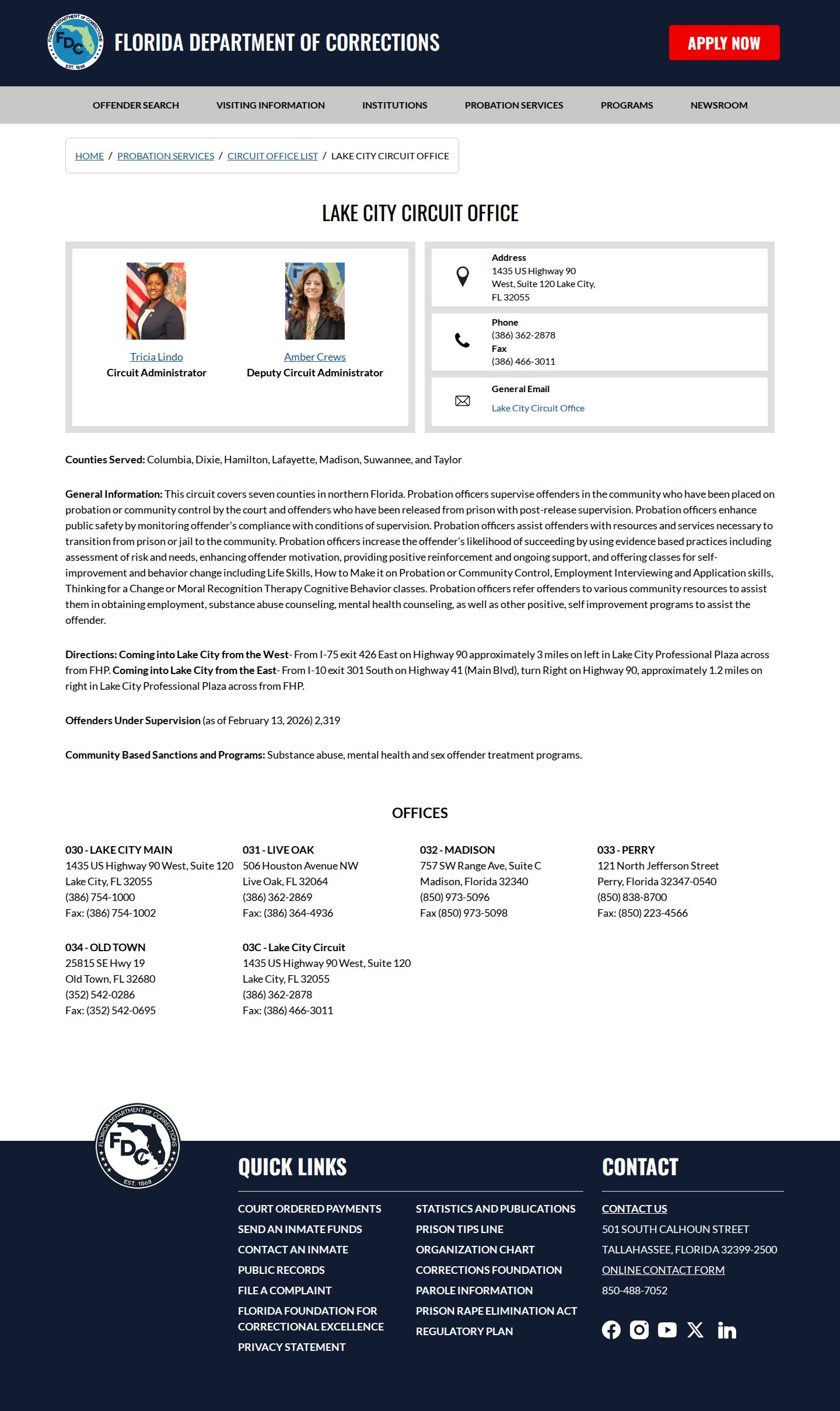
This local listing helps confirm the office, but only the matched FDC record or direct office response ties a specific person to that location. General supervision questions may also go to FDC Probation and Parole Field Services at 850-717-3444 or co-supervision@fdc.myflorida.com.
Taylor County Parole Hearing Records
FCOR's hearing schedule lists votes, conditional medical release votes, and teleconferences across the current and next month. A selected date opens a case agenda. Agenda fields can include a name, DC number, county, offense, case number, category, and whether the matter goes to a panel or the full commission.
An agenda is not a result. Labels such as Initial Interview, Effective Interview, Parole Supervision Review, Conditional Release Establishment, or Final Revocation Hearing state what is set for review. They do not say what FCOR decided. The county on an agenda can also be the conviction county rather than the person's release location.
The published FCOR schedule illustrates the meeting cadence, which can include several dates in a month rather than one monthly meeting.
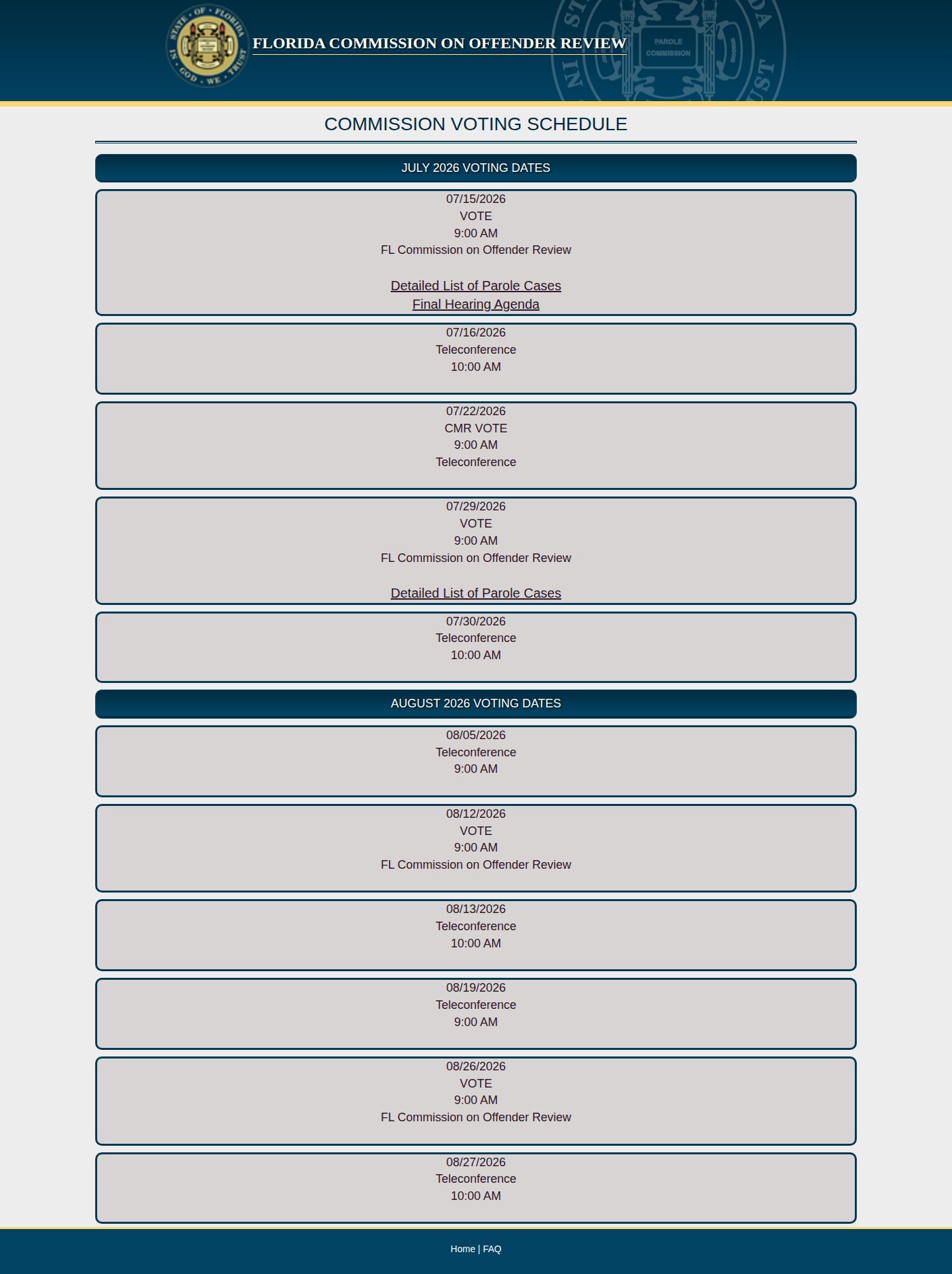
No official public name-searchable FCOR decisions database was verified. Request the final Commission Action, written order, vote sheet, or public disposition document from FCOR Public Records. Include the name, DC number, and hearing date. Then check FDC population, release, and supervision systems for the practical custody result.
Taylor County Absconder Warrant Checks
An absconder record belongs to the supervision layer. It means the person stopped making themselves available to FDC supervision and may be wanted. The FDC Absconder and Fugitive Search is the public statewide path. FDC reports weekly updates, except termination dates and location changes are updated nightly. Compare the DC number, name, photograph, and record details carefully.
TCSO advertises open or outstanding warrant searches in text, but the official pages reviewed did not expose a working public name-query endpoint. The sheriff's civil and warrant information does not turn its annual count of more than 1,500 warrants, writs, summonses, injunctions, and orders into a count of active warrants. Use FDC for a state supervision absconder and confirm a local warrant directly with TCSO. These are different legal records.
The FDC search form and result fields show the separate absconder channel.
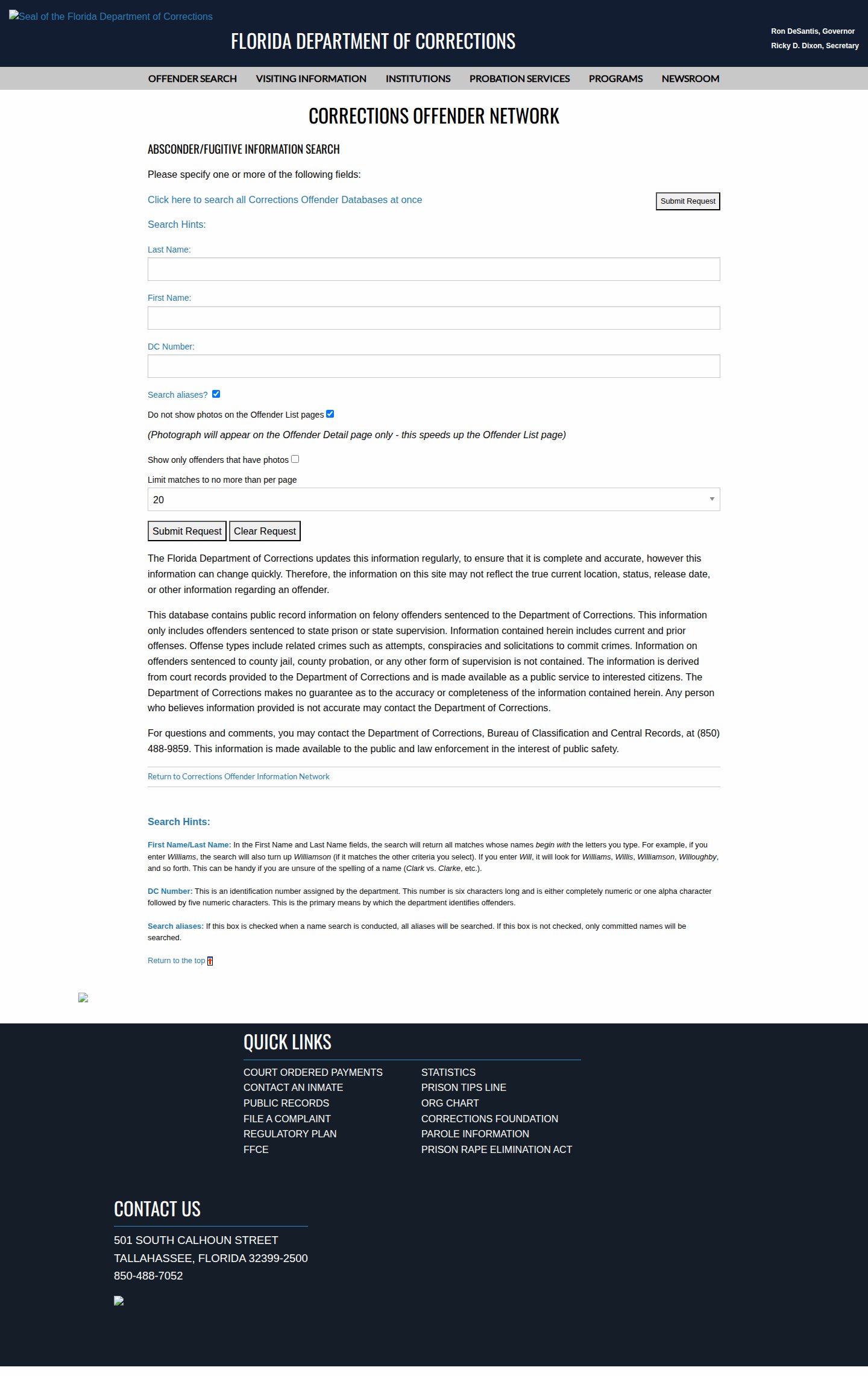
For record questions, the FDC Absconder Unit lists 850-717-3475 on weekdays from 8 a.m. to 5 p.m. Immediate location or safety concerns belong with law enforcement, not a public database.
Note: An ordinary arrest warrant is not automatically an FDC supervision absconder warrant; verify the issuing authority and record type.
Taylor County Supervision Changes
The controlling court order or FCOR action defines a supervision term. Conditions can include reporting, travel limits, treatment, payments, or other duties stated in that person's order. A public FDC result summarizes status. It does not provide a safe basis for guessing the full set of conditions, and it does not replace direct instructions from the correctional probation officer.
A claimed violation does not by itself show the final outcome. FCOR may continue, modify, or revoke supervision in matters within its authority. A court may act on probation through its own docket. An absconder entry can signal a failure to remain available, but the official warrant, violation report, hearing record, or order provides the legal detail. Use the exact terms in those records.
Release notifications and supervision records answer different questions. Florida VINE can report a custody movement for a specific person, but it does not replace the FDC supervision detail or the Taylor court order. The FDLE registered-offender system is narrower still. It applies only when a statutory registration duty exists and says nothing about most people leaving jail or prison. Choose the source by legal status, then confirm any change with the office responsible for that status.
Taylor County Supervision Discharge
Supervision ends through a formal termination or discharge, not merely because a projected date has arrived. Check the FDC termination field, then look for a later update or order. If FCOR had authority, request the Commission Action. If the Taylor court imposed probation or community control, read the docket for an order that terminates, modifies, or extends the term.
Custody release and supervision discharge belong to different record series. The broader Taylor County released-inmate search and release-record path explains how the jail event, court authority, VINE status, and FDC records work together. Keep the booking number, court case number, and DC number separate when requesting records. That prevents an office from searching the wrong system.
When the public record looks stale, ask the office that owns it. FDC directs release questions to 850-488-9167 or dc.release@fdc.myflorida.com, population corrections to 850-488-9859 or central.classification@fdc.myflorida.com, and supervision questions to its field-services contact. A Taylor Clerk order can establish the judicial end of a county term, while FDC confirms its own database status.
For an FCOR matter, preserve the hearing date and category before requesting the final action. A presumptive parole release date, effective parole release date, supervision review, and revocation matter have different effects. The Commission's order provides the outcome. The later FDC population, release, or supervision entry shows how that action appears in the correctional system. If the two seem inconsistent, quote both records rather than guessing which event occurred.
County probation can also exist without an FDC match because the statewide offender database excludes people sentenced only to county probation. In that situation, use the Taylor County criminal docket and the named supervising office in the order. The docket may show a probation term, later modification, warrant or capias, and termination. A capias is a court command to take a person into custody. It should not be confused with an FDC absconder entry.